Showing posts with label USD. Show all posts

Tuesday, August 28, 2012

Bernanke: To Print or Not to Print…?

In his latest Merk Insight letter, Axel Merk discusses the possible policy actions the federal reserver, via Ben Bernanke, make take, and although unlikely for now, one of the latest tool would be to lower the interest rate the Fed pays on bank reserves to possibly 10 basis points or zero.

Here's the full letter:

Official portrait of Federal Reserve Chairman ...
Official portrait of Federal Reserve Chairman Ben Bernanke. (Photo credit: Wikipedia)
To print or not to print? Odds are that Fed Chairman Bernanke has been contemplating this question while drafting his upcoming Jackson Hole speech. The one good thing about policy makers worldwide is that they may be fairly predictable. As such, we present our crystal ball as to what the Fed might be up to next, and what the implications may be for the U.S. dollar and gold.

First off, we may be exaggerating: on process rather than substance, though. That is, Bernanke isn’t just thinking about whether to print or not to print as he is sitting down to draft his speech. Instead, he considers himself a student of the Great Depression and has been pondering policy responses to a credit bust for some time. Consider the following:
  • Bernanke has argued that going off the gold standard during the Great Depression helped the U.S. recover faster from the Great Depression than countries that held on to the gold standard for longer.
    • Bernanke is correct: subject to many risks, debasing a currency (which going off the gold standard was) can boost nominal growth. Think of it this way: if the government takes your purchasing power away, you have a greater incentive to work. Not exactly the mandate of a central bank, though.
    • Note by the way that by implication, countries that hold on to the gold standard invite a lot of pain, but have stronger currencies. Fast forward to today and compare the U.S. to Europe. While neither country is on the gold standard, the Federal Reserve’s balance sheet has increased more in percentage terms than that of the European Central Bank since the onset of the financial crisis. Using a central bank’s balance sheet as a proxy for the amount of money that has been “printed”, it shouldn’t be all that surprising that the Eurozone experiences substantial pain, but the Euro has been comparatively resilient.
    • Possibly the most important implication: Bernanke considers the value of the U.S. dollar a monetary policy tool. When we have argued in the past that Bernanke might be actively working to weaken the U.S. dollar, it is because of comments such as this one. This is obviously our interpretation of his comments; a central banker rarely says that their currency is too strong, although such comments have increasingly been made by central bankers around the world as those pursuing sounder monetary policy have their economies suffer from competitive devaluations elsewhere.
  • Bernanke has argued that one of the biggest mistakes during the Great Depression was that monetary policy was tightened too early. Here’s the problem: in a credit bust, central banks try to stem against the flow. If market forces were to play out, the washout would be severe and swift. Those in favor of central bank intervention argue that it would be too painful and that more businesses than needed would fail, the hardship imposed on the people is too much. Those against central bank intervention point out that creative destruction is what makes capitalism work; the faster the adjustment is, even if extremely painful, the better, as the recovery is healthier and stronger.
    • If the policy choice is to react to a credit bust with accommodative monetary policy, fighting market forces, and then such accommodation is removed too early, the “progress” achieved may be rapidly undone.
    • We are faced with the same challenge today: if monetary accommodation were removed at this stage (interest rates raised, liquidity mopped up), there’s a risk that the economy plunges right back down into recession, if not a deflationary spiral. As such, when Bernanke claimed the Fed could raise rates in 15 minutes, we think it is a mere theoretical possibility. In fact, we believe that the framework in which the Fed is thinking, it must err on the side of inflation.
Of course no central banker in office would likely ever agree with the assessment that the Fed might want to err on the side of inflation. But consider the most recent FOMC minutes that read:
  • An extension [of a commitment to keep interest rates low] might be particularly effective if done in conjunction with a statement indicating that a highly accommodative stance of monetary policy was likely to be maintained even as the recovery progressed
As the FOMC minutes were released three weeks after the FOMC meeting, many pundits dismissed them as “stale”; after all, the economy had somewhat improved since the meeting. Indeed, it wasn’t just pundits: some more hawkish Fed officials promoted that view as well. But to make clear who is calling the shots, Bernanke wrote in a letter dated August 22 (the same date the FOMC minutes were released) to California Republican Darrell Issa, the chairman of the House Oversight and Government Reform Committee: “There is scope for further action by the Federal Reserve to ease financial conditions and strengthen the recovery.” Various news organizations credited the faltering of an incipient U.S. dollar rally on August 24 with the publication of this Bernanke letter.
For good order’s sake, we should clarify that the Fed doesn’t actually print money. Indeed, printing physical currency is not considered very effective; instead, liquidity is injected into the banking system: the Fed increases the credit balances of financial institutions in accounts held with the Fed in return for buying securities from them. Because of fractional reserve banking rules, the ‘liquidity’ provided through this action can lead to a high multiple in loans. In practice, one of the frustrations of the Fed has been that loan growth has not been boosted as much as the Fed would have hoped. When we, and Bernanke himself for that matter, have referred to the Fed’s “printing press” in this context, referring to money that has been “printed”, it’s the growth in the balance sheet at the Federal Reserve. That’s because the Fed’s resources are not constrained; it’s simply an accounting entry to pay for a security purchased; that security is now on the Fed’s balance sheet, hence the ‘growth’ in the Fed’s balance sheet.
Frankly, we are not too concerned about the environment we are in. At least not as concerned as we are about the environment we might be in down the road: that’s because we simply don’t see how all the liquidity can be mopped up in a timely manner when needed. At some point, some of this money is going to ‘stick’. Even if Bernanke wanted to, we very much doubt he could raise rates in 15 minutes. To us, it means the time for investors to act may be now. However, talking with both existing and former Fed officials, they don’t seem terribly concerned about this risk. Then again Fed officials have rarely been accused of being too far sighted. We are concerned because just a little bit of tightening has a much bigger effect in an economy that is highly leveraged. Importantly, we don’t need the Fed to tighten: as the sharp selloff in the bond market earlier this year (and the recent more benign selloff) have shown, as soon as the market prices in a recovery, headwinds to economic activity increase as bond yields are rising. That’s why Bernanke emphasizes “communication strategy”, amongst others, to tell investors not to worry, rates will stay low for an extended period. This dance might get ever more challenging.
In some ways, Bernanke is an open book. In his ‘helicopter Ben’ speech a decade ago, he laid out the tools he would employ when faced with a collapse in aggregate demand (the credit bust we have had). He has deployed just about all tools from his toolbox, except for the purchase of foreign government bonds; recently, he shed cold water on that politically dicey option. Then two years ago, in Jackson Hole, Bernanke provided an update, specifying three options:
  • To expand the Fed’s holdings of longer-term securities
  • To ease financial conditions through communications
  • To lower the interest rate the Fed pays on bank reserves to possibly 10 basis points or zero.
We have not seen the third option implemented, but the Fed might be discouraged from the experience at the European Central Bank: cutting rates too close to zero might discourage intra-bank lending and cause havoc in the money markets.

As such, expect Bernanke to give an update on his toolbox in Jackson Hole. The stakes are high as even doves at the Fed believe further easing might not be all that effective and could possibly cause more side effects (read: inflation). As such, we expect him to provide a framework as to why and how the Fed might be acting, and why we should trust the Fed that it won’t allow inflation to become a problem. For investors that aren’t quite as confident that the Fed can pull things off without inducing inflation, they may want to consider adding gold or a managed basket of currencies to mitigate the risk to the purchasing power of the U.S. dollar.
Enhanced by Zemanta

Wednesday, June 20, 2012

Axel Merk: Growth vs Austerity Analysis

Axel Merk, of Merk Funds, analyses both current economic models: Austerity and Growth; he tries to find out which one is more sustainable? Since Merk Funds focus on currency investments, he has a look at the implications on the U.S. dollar.

Here's the full newsletter:

To have budgets sustainable is as simple as matching revenue and expenses. Almost. Politicians have figured out that running a deficit may still yield a stable debt-to-GDP ratio, assuming there is economic growth. When U.S. politicians brag their budget forecasts bring down the absolute level of the deficit, it’s the debt-to-GDP ratio at best that may improve, assuming their rosy projections of economic growth prove correct. In the Eurozone, governments have – theoretically – committed themselves to running no more than 3% deficits, suggesting that such deficits lead to sustainable debt-to-GDP ratios. Not quite. Our research shows that, in order to achieve a long-term debt-to-GDP ratio in the low 50% range, deficits of no more than half of GDP growth may be run. If GDP growth is 3% a year, the deficit ought to be no higher than 1.5%. If 3% deficits are allowed, but GDP growth is only half of that – a more realistic assumption for many countries in today’s environment, the debt-to-GDP ratio will stabilize at above 200%. For a visualization of where the debt-to-GDP ratio will peter out given different growth and deficit scenarios, consider this table:
Average annual deficit Average GDP growth Long-term debt-to-GDP
1.5% 3.0% 51.5%
3.0% 3.0% 103.0%
3.0% 1.5% 202.9%
Why do we care about debt-to-GDP ratio? Allowing a high debt-to-GDP ratio is akin to playing with fire. Just look at the housing bust for an illustration as to what’s so dangerous about piling up too much debt: when interest rates are low, life feels great, the standard of living has gone up. But when interest rates move up, those with a higher debt load have to make disproportionate cuts to their standard of living to service their debt. According to the Congressional Budget Office (CBO), the U.S. paid an average of 2.2% of GDP in interest from 1972 until 2011. In its “Extended Alternative Fiscal Scenario” that assumes current policies, as opposed to current laws, remain in place, net interest payments will soar to 9.5% of GDP in 2037. In 2011, $454.4 billion in interest was paid in a $15 trillion economy; that is, 3% of GDP was spent in servicing interest payments. If the U.S. were to spend 9.5% of GDP to service its debt rather than 3%, it requires a cut of 6.5% of GDP in other services. It dwarfs the fiscal cliff (the reference to Bush era tax cuts running out coupled with spending cuts, absent of Congressional action) that might put a 3% to 5% dent on GDP. 

The pessimistic CBO outlook assumes what we judge to be an unrealistically low 2.7% average interest rate on debt payments. Should the market demand more compensation – generally referred to as bond vigilantes holding policy makers accountable – financing the deficits may no longer be feasible. Just ask Greece; or Spain.
With 10 year Treasuries yielding 1.6% in the United States, some argue that higher deficits are warranted. As the discussion above shows, the logic behind the view is fundamentally flawed, if not reckless. In the U.S., we differentiate between discretionary and mandatory spending. Mandatory refers to contractual obligations, the entitlements, most notably regarding Social Security and Medicare. Put simply, it may not be realistic in the long run to finance thirty years of retirement with forty years of work. As interest payments take a bigger chunk of GDP, discretionary spending is squeezed out. Be that an infrastructure project at the federal level; teachers at the state level; or firefighters or animal shelters at the local level.
In real life, there are some added complexities: we all fight for our benefits, take them for granted once granted and will fight vigorously to retain them. Also keep in mind that emergencies, such as natural disasters or wars, are typically not reflected in budget forecasts, as they might be considered “one off” items; even if that were correct, emergency spending adds to the deficit.
As debate rages whether austerity or growth is the solution to the plight of the developed world, keep in mind that there is a history spanning centuries, if not millennia, of governments spending too much money. In the old days, neighboring countries were “taxed” to fill domestic coffers: taxation, as in conquering other countries and taking treasures and slaves. Debt is a modern form of slavery, except that it is voluntary servitude. If history is any guide, don’t get your hopes up too high that these issues will be resolved. But investors may be able to navigate the waters, mitigate some of the risks or even profit from opportunities that arise in this environment.
The growth camp suggests that, with enough growth, a high debt load can be carried. That may be the case if such growth is not financed through debt. In recent years, trillions have been spent to achieve billions in growth – not exactly a recipe for sustainable budgeting.
The austerity camp suggests that, with enough austerity, books can be balanced. Except that, as services are cut, the economy is at risk of entering a downward spiral, increasing, rather than decreasing deficits. 

And while these two ideologies are being discussed, central banks struggle to either keep the banking system afloat (as in the Eurozone) or are helping to finance the government deficit (as in the U.S.). Indeed, the key difference between the U.S. and European model is that U.S. Treasuries appear to be backed by a) the taxing power of Congress and b) a lender of last resort, the Federal Reserve (Fed) with its printing press; whereas European sovereign debt is backed only by the taxing power of the national governments. The European Central Bank (ECB) has made it clear that its role is to support the banking system, not the sovereigns. In contrast, the Federal Reserve (Fed), while not admitting to outright financing of government deficits, has shown a willingness to do so in practice. As such, European sovereign debt is trading more like municipal bonds trade in the U.S., with weak “municipalities” (think Spain) paying a huge premium.
To be fair, the growth camp wants more than deficit spending; and the austerity camp wants more than cost cutting. Indeed, in a recent analysis Saving the Euro, we argued policy makers should instead focus on competitiveness, common sense and communication. Ultimately, both camps believe their philosophies should attract more investment as confidence is increased. In practice, the proverbial can is kicked down the road. By the time the can reaches the end of the road, it may be very beaten up. Indeed, an increasing number of investors are spreading their investments across multiple “cans” – we refer to these “cans” as diversified baskets of currencies, including gold.
What’s different between the U.S. and Europe is that the U.S. has a significant current account deficit. In our experience, countries with current account deficits tend to favor growth oriented strategies as they need to attract money from abroad to finance their deficit and, as such, to support the currency. While a bond market in shambles is a major drag on growth in the Eurozone, the Euro has been able to hold up reasonably well given the fact that the Eurozone’s current account is roughly in balance. A misbehaving bond market might have dire consequences for the U.S. dollar, even if one disregards the odds that the Federal Reserve may make U.S. Treasuries even less attractive by financing government spending (when a central bank buys a country’s own debt by printing money, such securities are intentionally over priced, potentially weakening the currency).

Wednesday, June 6, 2012

Axel Merk: What’s next for the U.S. Dollar? QE3?

Axel Merk, Merk Funds, has published a new "Merk Insights" newsletter entitled "What’s next for the U.S. Dollar? QE3?" where he discusses the outlook for the US currency.

The dismal U.S. jobs report for May, released last Friday, caused the price of gold to soar as the market appears to be pricing in an ever-greater chance of “QE3” – another round of quantitative easing by the Federal Reserve (Fed). But given that 10-year government debt is already down at 1.5%, the Fed may dive deeper into its toolbox in an effort to jumpstart the economy. Investors may want to consider taking advantage of the recent U.S. dollar rally to diversify out of the greenback ahead of QE3.

To a modern central banker, it may be very simple: if the economy does not steam ahead, sprinkle some money on the problem. The Fed has done its sprinkling; indeed, the Fed has employed what one may consider a fire hose. But after QE1 and QE2, we continue to have lackluster economic growth, unable to substantially boost employment. Never mind that the real problem the global monetary system is facing is that the free market has been taken out of the pricing of risk:
  • When the Fed buys government securities, such securities are – by definition - intentionally overpriced. Historically, when a central bank buys government bonds, the currency tends to weaken, as investors look abroad for less manipulated returns.
  • Policy makers increasingly manage asset prices, be that by pushing up equity prices through quantitative easing; artificially lowering the cost of borrowing of peripheral Eurozone countries; or by keeping ailing banks afloat.
Investors increasingly chase the next perceived move of policy makers, thus fostering capital misallocation. Policy makers in Spain may not like paying above 6% for their longer-term debt, but lowering such rates ought to be the result of prudent policies, not because of a game of chicken between the Spanish prime minister and other European policy makers (if we only knew who the other chickens were – they are all hiding!). Similarly, U.S. growth is lagging because – let’s just name a few of the root causes - of ongoing global de-leveraging; the de-leveraging of U.S. households; uncertainty over U.S. regulatory policy; uncertainty over U.S. fiscal policy.
But let’s keep it simple, as it doesn’t matter what we think. What matters is what our policy makers do. Bernanke has indicated that the Fed is willing to provide more support to the economy. The latest unemployment report might provide that impetus, especially given Bernanke’s view that “The central bank should act more preemptively and more aggressively than usual.” This quote comes straight from what may be considered Bernanke’s playbook: his 2002 “helicopter speech” on how deflation can be beaten. Last fall, we browsed through the playbook to pose the question: Operation Twist a Primer for QE3? To recall, Bernanke argues:
  • Deflation is in almost all cases a side effect of a collapse of aggregate demand….The best way to get out of trouble is not to get into it in the first place…The Fed should try to preserve a buffer zone: …central banks … set … inflation targets … between 1 and 3 percent, … reducing the risk that a large … drop in aggregate demand will drive the economy far … into deflationary territory
When faced with deflation:
  • The central bank should act more preemptively and more aggressively than usual…
  • Deflation is always reversible under a fiat money system…the U.S. government has a technology, called a printing press (or, today, its electronic equivalent) that allows it to produce as many U.S. dollars as it wishes at essentially no cost… a determined government can always generate higher spending and hence positive inflation.
QE1 has come:
  • The Fed must expand the scale of its asset purchases or, possibly, expand the menu of assets that it buys.
Operation Twist and a commitment to keeping interest rates low for an extended period is also taken from the playbook:
  • One relatively straightforward extension of current procedures would be to try to stimulate spending by lowering rates further out the Treasury term structure – that is, rates on government bonds of longer maturities.
    • One approach…would be for the Fed to commit to holding the overnight rate at zero for some specified period.
    • A more direct method, which I [Bernanke] personally prefer, would be for the Fed to begin announcing explicit ceilings for yields on longer-maturity Treasury debt. The Fed could enforce these interest-rate ceilings by committing to make unlimited purchases of securities… at prices consistent with the targeted yields... if operating in relatively short-dated Treasury debt [next two years] proved inefficient, the Fed could also attempt to cap yields of Treasury securities at still longer maturities, say three to six years.
    • Yet another option would be for the Fed to use its existing authority to operate in the markets for agency debt (for example, mortgage-backed securities [MBS] issued by Ginnie Mae, the Government National Mortgage Association).
We had the MBS purchase program as QE1. We don’t think a targeting of longer-term interest rates is in the cards, as rates are already quite low. To see what may be announced by the Fed in the near future, keep reading (emphasis added):
  • Alternatively, the Fed could find other ways of injecting money into the system – for example, by making low-interest rate loans to banks or cooperating with the fiscal authorities
  • If lowering yields on longer-dated Treasury securities proved insufficient to restart spending, however, the Fed might next consider attempting to influence directly the yields on privately issued securities… the Fed does have broad powers to lend to the private sector indirectly via banks, through the discount window.
  • The Fed could offer fixed-term loans to banks at low or zero interest, with a wide range of private assets (including, amongst others, corporate bonds, commercial paper, bank loans, and mortgages) deemed eligible as collateral.
What does that mean? Look at Europe’s Long Term Refinancing Operations (LTROs). In Europe, the European Central Bank (ECB) has been providing unlimited liquidity to the banking system, allowing banks to get liquidity in return for a broad range of collateral. While U.S. banks are not in as dire a situation as European banks, Bernanke may be motivated to provide LTROs Fed style because it would allow banks, such as Bank of America, to turn their illiquid mortgage backed securities onto the Fed in return for liquidity. Key differences to QE1 and QE2 are:
  • An LTRO is demand driven. Rather than the Fed buying a colossal amount of securities, unsure of what to do with a bloated balance sheet, the LTRO gets the money where it is in demand. A bank that wants increased liquidity – presumably to invest the money in riskier assets – will be willing to participate in the LTRO.
  • LTROs are extremely profitable to banks rather than the Fed. Currently, the Fed earns over $80 billion a year: the more money a central bank prints, the more interest paying securities are purchased, thus the more “profitable” the central bank is (never mind the potentially eroded purchasing power as a result of having printed the money). The ECB, in contrast, only charges 1% in return for cash provided on collateral. Given the near zero interest rates in the U.S., expect the Fed to charge only a nominal amount to turn securities held by banks into cash.
What may hold Bernanke back is that he can’t be sure of the impact a U.S. style LTRO might have:
  • One important concern in practice is that calibrating the economic effects of nonstandard means of injecting money may be difficult, given our relative lack of experience with such policies.
Indeed, we have been critics of the ECB’s LTRO because over one trillion euros in liquidity will need to be drained within a matter of weeks should the LTRO be closed out. We don’t think this is feasible. However, the reason why these “nonstandard measures” have not caused major inflation is because policies in the U.S. and the Eurozone have not worked – the money doesn’t “stick.” With the U.S. recovery further along than the Eurozone recovery, the risk for Bernanke – and with that to the purchasing power of the U.S. dollar – is that banks will actually use the LTRO to get the economy going. If so, Bernanke claims to be able to raise rates in 15 minutes. We will see about that, especially in the context of his conviction that one of the biggest mistakes during the Great Depression was to raise rates too early. In our assessment, Bernanke must err on the side of inflation if he wants to stay true to his convictions. It’s in that context that he has been willing to commit to keeping interest rates low until the end of 2014; incidentally, by that time, odds are high that much of the foreclosure pipeline will have been worked through thus allowing the Fed to return to more traditional monetary policy. That’s the theory. In practice, little has worked out since the onset of the financial crisis as has been envisioned by policy makers; then again, the Fed is rarely accused of being too far sighted…
In summary, we believe the next major initiative by the Fed will be the announcement of a U.S. style LTRO. Just in case that doesn’t jumpstart the U.S. economy either, we will have to revert back to Bernanke’s playbook to glimpse what else may be in store:
  • The Fed can inject money into the economy in still other ways. For example, the Fed has the authority to buy foreign government debt, as well as domestic government debt. Potentially, this class of assets offers huge scope for Fed operations, as the quantity of foreign assets eligible for purchases by the Fed is several times the stock of U.S. government debt.
This policy suggestion demonstrates Bernanke’s lack of appreciation for the political consequences of his actions. In his speech, he tries to address that:
  • I want to be absolutely clear that I am today neither forecasting nor recommending any attempt by U.S. policymakers to target the international value of the dollar. Although… it’s worth noting that there have been times when exchange rate policy has been an effective weapon against deflation.
Our read is that Bernanke won’t consider the outright purchases of peripheral Eurozone debt until after the U.S. elections. Even then, such a step may go beyond the bizarre. Then again, what hasn’t been bizarre in U.S. monetary policy in recent years?
Back to the LTRO, such a policy would boost the Fed’s balance sheet yet again. New money would be “printed” to provide the liquidity offered to the banking system. We live in an environment where central banks hope for the best, but plan for the worst. A U.S. LTRO would squarely fit that scheme. In that environment, the U.S. dollar may weaken and currencies sensitive to monetary stimulus may shine yet again. Having said that, we have long argued that there may not be any safe asset anymore and investors may want to take a diversified approach to something as mundane as cash.

Thursday, May 17, 2012

Merk G10 Currencies Monetary Score

Merk Funds has recently released a white paper entitled "G10 Currencies: A Monetary Policy Analysis" where they analyzed G10 currencies and gave a "Merk Monetary Score" to each of those.

The Merk Fiscal Score and a Merk Economic Score are aggregated together with the The Merk Monetary Score into an overall Merk Currency Score

In this 7-page white paper, they explains their methodology and the Merk Monetary Policy Score eventually ranks monetary zones as follows:

  1. Australia
  2. Canada
  3. New Zealand
  4. U.S.
  5. Sweden
  6. Euro Area
  7. Norway
  8. Japan
  9. UK
  10. Switzerland
The best currencies in terms of monetary policy would then be the Australian dollar and the Canadian dollar and the  worst currencies the British pound and the Swiss franc.

Thursday, April 12, 2012

Axel Merk: Recovery – Who are We Kidding?

Axel Merk published a new Merk Insights newsletter entitled "Recovery - Who are We Kidding?", where he explains we are in a period of war between inflation forces (central banks) and deflationary forces (markets), talks about the potential consequence of Ben Bernanke monetary policies and recommend diversifying into hard currencies including Gold on US dollar strength.

The Federal Reserve: The Biggest Scam In History
The global economy is healing, so we are told. Yet, the moment the Federal Reserve (Fed) indicates just that – and thus implying no additional stimulus may be warranted – the markets appear to throw a tantrum. In the process, the U.S. dollar has enjoyed what may be a temporary lift. To make sense of the recent turmoil, let’s look at the drivers of this “recovery” and potential implications for the U.S. dollar, gold, bonds and the stock market.

In our assessment, what we see unfolding is the latest chapter in the tug of war between inflationary and deflationary forces. During the “goldilocks” economy of the last decade, investors levered themselves up. Homeowners treated their homes as if they were ATMs; banks set up off-balance sheet Special Investment Vehicles (SIVs); governments engaging in arrangements to get cheap loans that may cost future generations dearly. Cumulatively, it was an amazing money generation process; yet, central banks remained on the sidelines, as inflation – according to the metrics focused on - appeared contained. Indeed, we have argued in the past that central banks lost control of the money creation process, as they could not keep up with the plethora of “financial innovation” that justified greater leverage. It was only a matter of time before the world no longer appeared quite so risk-free. Rational investors thus reduced their exposure: de-levered. When de-leveraging spreads, however, massive deflationary forces may be put in motion. The financial system itself was at risk, as institutions did not hold sufficiently liquid assets to de-lever in an orderly way. Without intervention, deflationary forces might have thrown the global economy into a depression.
The trouble occurs when the money creation process takes on a life of its own, because the money destruction process is rather difficult to stop. However, it hasn’t stopped policy makers from trying: in an effort to fight what may have been a disorderly collapse of the financial system, unprecedented monetary and fiscal initiatives were undertaken to stem against market forces. Trillion dollar deficits, trillions in securities purchased by the Fed with money created out of thin air (when the Fed buys securities, it merely credits the account of the bank with an accounting entry – while no physical dollar bills are printed, many – including us – refer to this process as the printing of money).
Will it work? The Fed thinks it might. But nobody really knows. We do know that a depression works in removing the excesses of a bubble. However, the cost of a depression may be severe, both in social and monetary terms. Critics of the “let ‘em fail” argument say that businesses and jobs beyond those that have engaged in bad decisions will be caught by contagion effects and may ultimately be bound to fail too. Fed Chair Bernanke, a student of the Great Depression, frequently warns against repeating the policy mistakes of that era. So does the reflationary argument work, i.e. does printing and spending money help bring an economy back from the brink of disaster? We cannot find an example in history where it has. As Bernanke points out, policy makers have learned a great deal by studying crises of the past. Our reservation comes from the following observation: central bankers at any time have always been considered amongst the smartest of their era, yet – with hindsight – they may have engaged in terrible mistakes. While we certainly wish that Bernanke is right, we nonetheless maintain a degree of skepticism and believe it is any investor’s duty to take the risk that the world does not evolve the way he envisions into account. Our policy makers also might be well served to be more humble, as they are putting the world’s savings at risk. Yet, the reason central bankers are bold, not humble, is because they fear hesitation will lead to deflationary forces taking the upper hand yet again. Bernanke’s contention, that one of the biggest mistakes during the Great Depression was to tighten monetary policy too early, stems from that fear. In its recently released minutes, the Federal Reserve Open Market Committee (FOMC) placed that fear in today’s context: “While recent employment data had been encouraging, a number of members perceived a non negligible risk that improvements in employment could diminish as the year progressed, as had occurred in 2010 and 2011, and saw this risk as reinforcing the case for leaving the forward guidance unchanged at this meeting."
In our view, the reason why the Fed is committed to keeping rates low until the end of 2014 is precisely because the Fed does not want to be perceived as tightening too early. Why the end of 2014? Well, because it’s not today or tomorrow. We believe nobody – not even at the Fed – knows whether the end of 2014 is the right date. The problem with that policy will be when the market no longer buys it. The market just needs to see one member of the FOMC turn more hawkish, as a result of improving economic data, to interpret that we may be starting down the road of monetary tightening. Yet, if the market thinks the Fed may tighten, deflationary forces take over, possibly unraveling all the “hard work” the Fed has done.

Will tightening ever be bearable for the economy again? U.S. financial institutions are in a stronger position than they were in 2008. Conversely, governments around the world – not just the U.S. government – are in far weaker positions, given the large amounts of debt they have incurred, in an effort to manage the financial crisis. Many consumers have downsized (read: lost their homes / filed for bankruptcy), but there continues to be downward pressure on the housing market, as millions of homes remain in the foreclosure process and are only slowly making it to the market. Bernanke may have chosen the end of 2014 as the earliest time to raise rates because it represents a date when the housing market may have freed itself from much of the foreclosure pipeline. Indeed, Fed research suggests that residential construction won’t fully recover until 2014. We don’t think that is a coincidence. To Bernanke, a thriving home market appears to be key to a healthy consumer and thus a healthy and sustainable recovery in consumer spending.
Tying monetary policy to the calendar has created alarm with economic “hawks” – not just the Fed itself, with the lone hawkish voting FOMC member, Richmond Fed President Jeff Lacker, openly dissenting. But if one follows Bernanke’s line of thinking, what’s the alternative? The alternative would be to firmly err on the side of inflation, as the Fed thinks inflation is the one problem it knows how to fight. Except that a central bank must never communicate that it wants to induce inflation, as it may derail the markets. So the 2nd best option, from Bernanke’s point of view, may be to commit to keeping rates low until the end of 2014; the “risk” that the economy might perform better than expected (and thus earlier tightening warranted) appears to be shoved aside. Just to make sure the markets behave, the Fed also introduced an inflation target, assuring the markets not to worry, all will be fine on the inflation front.
Unfortunately, we don’t think Bernanke’s plan will work. The reason is that inflation may not be as easily fought as Bernanke thinks. The extraordinary policies that have been pursued have not only planted the seeds of inflation, but have re-introduced leverage into the system. While Bernanke claims he can raise rates in 15 minutes, we believe there is simply too much leverage in the economy to raise rates as much as former Fed Chair Paul Volcker did in the early 1980s to convince the markets the Fed is serious about inflation. Given the increased interest rate sensitivity of the economy, much less tightening would likely be necessary. We are not as optimistic as many current and former Fed officials that it will be possible to engineer a sustainable economic growth while adhering to the Fed’s inflation target. The Fed is ultimately responsible for inflation; however, we have also learned that the modern Fed is unlikely to risk severe economic hardship to achieve its price stability mandate.
What does it all mean for the markets? Deflationary forces have favored the U.S. dollar and been a negative for gold. As indicated, however, we don't think the Fed will sit by idly as the markets price in tightening before the economy is “ready”. As such, a flight into the dollar out of gold might be an opportunity to diversify out of the dollar into a basket of hard currencies, including gold. With regard to the bond market, we are rather concerned that the long end of the yield curve has been extraordinarily well behaved until just a few weeks ago. The reason for our concern is that periods of low volatility in any asset class usually means that money has entered the space that might leave on short notice: we call it fast money chasing yields. We don’t need a crisis for investors to run for the hills in the bond market; we may just need a return to more normal levels of volatility. As such, investors may want to consider keeping interest risk low, i.e. staying on the short-end of the yield curve, both in U.S. dollars and other currencies. With regard to the stock market, it may do well should the Fed think of another round of easing, but let’s keep in mind that the stock market has had a tremendous rally in recent months.
If investors consider investing in the stock market because of the Fed’s monetary policy, why not express that same view in the currency market? After all, currencies – when no leverage is employed – are historically less volatile than domestic (or international) equities. Currencies may give investors the opportunity to take advantage of the risks and opportunities provided by our policy makers without taking on the equity risk.
Enhanced by Zemanta

Tuesday, March 6, 2012

Axel Merk: Fed Flying Blind and Poses Risk to the US Dollar

Axel Merk, Merk Funds, published a new "Merk Insights" newsletter entitled "Fed Flying Blind" where he explains that the voice of reason (i.e. "the market"), who is supposed to tell the federal reserve to stop printing money, has been silenced and this poses potential risks to economic stability, as well as the U.S. dollar.

Here's the the full Merk Insights letter below:

The entrance to the Federal Reserve Bank of Sa...
Federal Reserve
As the Federal Reserve (Fed) has become ever more engaged in micro-managing the economy, we have moved from rate cuts to emergency rate cuts, to printing billions, then trillions, first to buy mortgage backed securities and more recently, Treasuries. Coming to the realization that talk is cheaper than action, the Fed has since switched gears and “committed” to keeping rates low, initially through mid-2013 and now through the end of 2014. The Fed has a buzzword to describe its policies: “transparency”; instead, you may want to call it the “fear not – we will take care of you” policy. There are reasons the Fed needs to signal that rates will stay low for such an extended period, amongst them: a reasonable person may believe that current monetary policy could be inflationary; a reasonable person may believe that the Fed actually wants to have inflation to bail out homeowners that are under water in their mortgages; finally, a reasonable person may have paid attention to Fed Chair Bernanke when he argued that raising rates too early was one of the biggest policy mistakes during the Great Depression, concluding that erring on the side of inflation is desirable. But “fear not – we will take care of you” is the message: the Fed is introducing an inflation target, providing assurance that inflation won’t be a problem.

The alternative, of course, would be to conduct what we would deem sound monetary policy, so that a reasonable person wouldn’t be concerned about the risks of money printing in the first place. But that’s so yesterday. Instead, the Fed has engaged in Operation Twist, applying the Fed’s firepower to lowering rates further out the yield curve (longer term interest rates). Indeed, the Fed now owns over 30% of all outstanding marketable U.S. Treasuries with maturities of 6-10 years; across the yield curve, from Treasury Bills to 30-year Treasury Bonds, the Fed has accumulated almost 20% of all outstanding securities.1 These days, the Fed owns more U.S. government debt than China.

As long as there is confidence in the Fed, the Fed’s strategy may pan out, right? Maybe. We don’t even question the motives of the Fed. However, we question the Fed’s ability to conduct policy when its policy makers are blindfolded. We fear that some of the Fed’s most important gauges used to set policy have been taken away, by the Fed itself. As if to prove the point himself, Fed Chair Bernanke told Congress last week that he is puzzled about incoming economic data, unable to explain why the unemployment rate has come down quite so rapidly. Consider the yield curve: typically, yields provide a wealth of information about the health of the economy, about inflationary pressures, to name a few. As such, an important feature of the yield curve is that it can sell off, amongst others, should inflationary pressures pick up or should investors be concerned about long-term fiscal sustainability. With the Fed becoming evermore engaged in yield curve management further along the curve, this gauge has been taken away.
Former Fed Governor Kevin Warsh, a critic of active yield curve management, has said the Fed is looking into the mirror in conducting policy. We agree. Luckily, the folks at the Fed are some of the smartest economists around. Unfortunately, though, they are human and should periodically be reminded that the greatest failures in monetary history have also been conducted by some of the smartest economists of the time.

If it weren’t enough that the Fed is blindfolded, the Administration and Congress are no better off. At some point, bondholders might get antsy about unsustainable fiscal policies. Without major policy initiatives, the non-partisan Congressional Budget Office (CBO) estimates that the U.S. deficit will grow by $3.86 trillion (the 2013-2017 adjusted baseline scenario in the 2013 budget). Should the Administration be able to implement all its policy initiatives, the five-year addition to the deficit would “only” be $3.44 trillion. The math includes $560 billion in additional revenue by phasing out the Bush-era tax cuts. Should Congress find a way to extend those tax cuts, the Administration’s proposals actually increase the deficit by $140 billion over the next five years (our special thanks to our Senior Economic Adviser Bill Poole, who helped us understand a budget that is most challenging to understand, even for experts). The tragedy here is that fiscal deficits are not taken seriously. We point this out not to single out the Administration: neither Congress, nor the presidential candidates, have come up with clear initiatives that would actually put the budget on a sustainable path.

Why not? Because the bond market lets policy makers get away with squandering money. Not so in Europe: Thanks to the “motivation” provided by the bond market, European policy makers are engaged in very serious structural reform. In our assessment, the language of the bond market is the only language policy makers understand. With the Fed’s micro-management of the entire yield curve, warning shots by the bond market may come much later than they otherwise would. As we have seen in Europe, the longer policy makers wait before engaging in reform, the more painful the consequences. Ultimately, the Fed may not be strong enough to fight market pressures, but that may be of little consolidation: unlike the Eurozone, the U.S. has a significant current account deficit. Whereas in the Eurozone, notwithstanding significant bond market turmoil causing political havoc and pain, the euro held up relatively well, surprising most pundits to the upside. In contrast, a volatile bond market may have more dire consequences for the U.S. dollar, as it might be increasingly difficult to encourage foreigners to finance U.S. deficits.

It was in the earlier part of last decade when the late Wim Duisenberg, European Central Bank (ECB) President until 2003, said, “We hope and pray that there will be an orderly adjustment to global imbalances.” – in those days, we were concerned that policy makers were overly reliant on hopes and prayers for solutions. Now, hope and prayer has moved to the forefront of Fed policy making, as the Fed has taken away what we deem are some of the most important gauges used to conduct monetary policy. Unfortunately, hope and prayer are no substitute for sound policy making. Prudent investors, as well as investment professionals with fiduciary duty over client accounts, may want to take this risk into account when allocating within their portfolios.

Tuesday, January 31, 2012

Japanese Yen: The Next Currency Crisis ?

We now have a debt crisis in Europe, that could well turn into a currency crisis. In the meantime, the Japanese Yen (JPY) is stronger than ever, although Japan's public debt to GDP has reached an amazing 220% of GDP.

The reasons for the strength of the Japanese Yen have been  its low external debt (most debt is owned by Japanese), large reserves and current account surplus.

However, Japan had a trade deficit in 2011, the first time since 1980 (See chart below courtesy of Trading Economics). The current account was still positive, but greatly reduced compared to previous years. If the trade deficit was to continue it could weaken the Yen, making it less of a safe heaven, and increase interest rates, which could snowball into a debt crisis and quickly deteriorate in a currency crisis.


Many people see Asian currencies, as being strong currencies. However, in 2011, with India debt to GDP over 90%, the Indian Rupee declined by up to 15% against the US dollar, although it recently rallied somewhat.
What really destroys a currency is debt. Any currency with large amount of debt is at risk nowadays. There are not many fiat currencies that could qualify as safe haven now. For that reason, I don't consider the Japanese Yen and (especially) the US dollar as safe investment at least in the long term.

If you want to learn more about the Japanese Yen risk, check Mish Shedlock and Kyle Bass.

Tuesday, January 3, 2012

Jim Rogers: Buy the Euro and the Swiss Franc in 2012

Apparently, despite all the talks about a currency crisis in Europe, I'm not the only one to think the Euro may be a buy in 2012, as Jim Rogers was interviewed on CNBC on the 3rd of January 2012 saying he would consider investing in the European currency along with the Swiss Franc. The main reasons he wants to invest in the Euro are the large short position in the Euro and the fact that it is an election year in France, so they will probably do something (spend money or monetize the debt) to make the market feel better for a while. However, he believes this would be a terrible mistake and we'll have to pay the price in 2013-2014.
I'm also worried about the Japanese Yen, as in the last few month they had a trade deficit. If this persists, it would be negative for the Yen. I suppose Jim Rogers plans to convert some of his Japanese Yen holdings into Euro and CHF.

Friday, December 2, 2011

Peter Schiff: The Real Currency Crisis is Coming to the US

Interview with Peter Schiff on Fox Business News (1st of December 2011) where he explains the Eurozone has severe problems but it's nothing in comparison to the United States and that the real currency crisis is coming to the US to the dismay of Fox Business host.

Wednesday, November 2, 2011

The US Dollar, Gold and Politics

In his latest "Gold report", Peter Schiff talks about the politics of Gold investments where he analyses the price of Gold and the US dollar based on which US presidential candidate is elected President in 2012. Each candidate has different views on monetary policies and debt reductions. Here are the results:
  • Herman Cain: Bullish for Gold, Bearish for the dollar
  • Mitt Romney: Very Bullish for Gold, very bearish for the dollar
  • Ron Paul: Bullish for Gold, Bullish for the dollar
  • Rick Perry: Bullish for Gold, Bearish for the dollar
  • Newt Gingrich: Bullish for Gold, Very bearish for the dollar
  • Obama: The Gold Rush is On !
He however mention that with Ron Paul the direction of the price of Gold is more difficult to access as after 2 years in his presidency he would probably put in place a very hawkish president of the federal reserve.

To conclude, if Ron Paul is not elected president of the US, you can rest assured that your Gold investments will most probably do well for years to come.

Wednesday, October 19, 2011

U.S. Dollar and Euro - Review and Outlook

Axel Merk & Kieran Osborne, CFA, Merk Funds have just published their outlook for the US dollar, the Euro, the Chinese RMB and several other currencies.

They have a bearish view on the US dollar:
Policy makers in Washington didn’t help appease market concerns: leaving the decision to raise the Government’s debt ceiling to the last minute only exacerbated market fears of a U.S. default and further degraded investor’s view of policy makers; ...Standard & Poors subsequently downgraded the credit rating of the U.S. government, citing the inability of the political leadership to come together and agree on a plan to sustainably rein in the deficit over the long term as a key reason for downgrade. We consider these developments have further eroded the safe haven and reserve currency status the U.S. dollar has held for so long, and continue to view the outlook for the U.S. dollar negatively over the medium to long term.
...
minutes from the FOMC meeting show there was support for further expansionary monetary policy, or quantitative easing, which would constitute “QE3”. It is our assessment that the likelihood of the Fed instigating QE3 has risen significantly, in part due to the weakening economic outlook, but also because of the composition of voting members next year. All three dissenting voices will be replaced in 2012 and the average monetary policy stance of voting members will become much more dovish (only one voting member is considered a hawk – Jeffrey Lacker, the Richmond President)1. With inflation expectations declining, we consider Fed Chairman Bernanke may again present the need for further easing, arguing deflationary risks have become elevated, or at the very least, that further easing will not generate significant inflationary pressures. We believe the impending FOMC composition may consider this argument compelling, and is likely to err on the side of overstimulation. All of which leads us to believe that the outlook for the U.S. dollar remains to the downside.
even if in the short term there are risk, they are bullish on the Euro in the medium to long term:
Europe certainly has problems, but in an odd way, it is the inflexibility of its political make-up that may lead to a stronger euro over the foreseeable future. ...
Many individual countries find themselves with very weak political leadership, but interestingly, have instigated, in many cases, very strict austerity measures with opposition support. The issues facing the Eurozone are significant, and there is no simple, easy solution; it’s likely to be a drawn out process rectifying years of malinvestment brought about by unconscionably low funding rates for periphery nations (Greece could borrow at rates similar to Germany for years leading up to the crisis). In turn, economic growth may be restrained over the foreseeable future. Note, however, that economic growth is not necessarily a precondition for a strong currency; it is not incompatible to have poor economic growth on the back of a strong currency – just look at Japan.
...
We believe two key reasons have contributed to Japanese yen strength – weak leadership and a current account surplus.
...
On the above two factors, the Eurozone is not so dissimilar to Japan: the Eurozone has a broadly balanced current account, fiscal union is disjointed at best, and many individual nations have very weak political leadership. Furthermore, the ECB has a sole mandate of price stability, and is reticent to provide any direct bailout funding or directed asset purchases to the financial industry, or specific sovereigns, for fear of overstepping its bounds (or being taken to court by the Germans).
...
As a result, we consider the euro can appreciate on the backdrop of weaker economic growth and continued divergence in monetary policies
Finally, they mention they still have a positive view of the Chinese Yuan:
We continue to see upside potential in the Chinese renminbi and believe policy makers will continue to be incentivized to allow the currency to appreciate to tackle domestic inflationary pressures.

The full outlook is available at http://www.merkfunds.com/merk-perspective/insights/2011-10-19.html

Saturday, October 15, 2011

The Death of the Euro

Here's an interesting debate about the Euro on CrossTak, RussiaToday on the 14th of October 2011.

How much liquidity is needed to save the Eurozone? Why go in more debt to overcome deadly indebtedness? And is Germany going to remain the prime sponsor of the euro experiment? Will we see the Eurozone change its boundaries? CrossTalking with Andrew Lilico (Clue: He's the man!), Jeff Madrick (Keynesian clown) and Jon Gaun (Eurosceptic) on October 14.

There is also an interesting part in the interview where they discuss whether TARP solved the US problem or not and Andrew Lilico compares the US debt situation with the one's of Italy.


Thursday, September 22, 2011

Jim Rogers: The US Dollar is not a Safe haven

Interview with Jim Rogers on CNBC on the 22nd of September 2011.

He said right now he would just hold USD, CHF (Swiss Franc) or Agriculture, although he does not consider the US dollar to be a safe haven in the long term.


Wednesday, September 7, 2011

Jim Rogers: The Chinese yuan is the next safe haven currency.

Jim Rogers was interviewed on CNBC on Wednesday 7th September 2011 to discuss the recent move by the SNB (Swiss National Bank). Here are his views on the move and the Chinese yuan:

"The Swiss central bank's decision to set a limit on how much the Swiss franc can appreciate against the euro is "a huge mistake". The move will work for a while, but the market will have more money in the end than the SNB which risks losing a lot of money buying up lots of foreign currencies which they will eventually sell at a loss. Another risk is that the central bank will totally debase the Swiss franc trying to keep Switzerland 'competitive' which will then destroy the traditional Swiss financial industry. So this is a huge mistake for Switzerland since they are going to suffer more either way"

"RMB is best, the US dollar is probably good in the short term, but the absolute worst over the long term. There are various ways to get RMB exposure outside China, investors can now open bank accounts in renminbi in various cities like New York, San Francisco, Hong Kong, Singapore and others and can buy renminbi-denominated bonds in the international markets."

Tuesday, September 6, 2011

CHF is now effectively pegged to Euro at 1.20

In a dramatic move, the SNB has decided to put a floor on the price of the CHF vs Euro, a floor at 1.20 CHF per Euro. This is a defacto peg to the Euro as the Swiss franc is unlikely to decline and this resulted in a massive 8% move in the Swiss Franc / Euro exchange rate a massive move (probably unheard of) in the currency markets. (See chart below. Source: Yahoo Finance)


Another battle has been fought in the currency war and the Swiss Franc is no longer a safe heaven. There remains the Yen (but I wonder why) and possibly the Singapore dollar (SGD) which appreciated around 6% against the USD since the beginning of the year. Of course, there is still gold and silver which should remain the real safe heavens.

Tuesday, August 23, 2011

Axel Merk Remains Bullish on the Euro

Axel Merk, who manages Merk Hard Currency Funds (MERKX), is interviewed on the Daily Ticker (Yahoo Finance) by Aaron Task on the 23rd of August 2011.

Merk thinks the Euro will outperform the US Dollar because the ECB prints less money than the Federal Reserve and Europe has implemented austerity measures, which we have yet to see in the US.

He also believes that after a European fiscal framework is implemented, we should see Eurobonds. However, he warns that this is a long process and there is no silver bullet to solve the current European currency crisis.


Thursday, August 18, 2011

Why is the US dollar a doomed currency ?

First of all, the US dollar is a weak currency because of the USA current account deficit which stands at 561 billions dollars in 2010 according to Wikipedia List of countries by current account balance. The US is actually last in this ranking (191), with Spain being number 190 with a current account deficit of 6.740 billions.

A large current account deficit is the result of an imbalance between exports and imports.

Second, the USA also has massive debt obligations with current government debt of 14.6 Trillions (Source: Debt Clock) excluding unfunded liabilities. That debt represented 92.7% of GDP in 2010 according to the IMF, and is close to 100% now. Some historical studies (cf. "Growth in a Time of Debt", Reinhart and Rogoff)explain that when a country debt to GDP is over 90%, the likelihood of paying down the debt decreases significantly as it affects economic growth rates negatively.

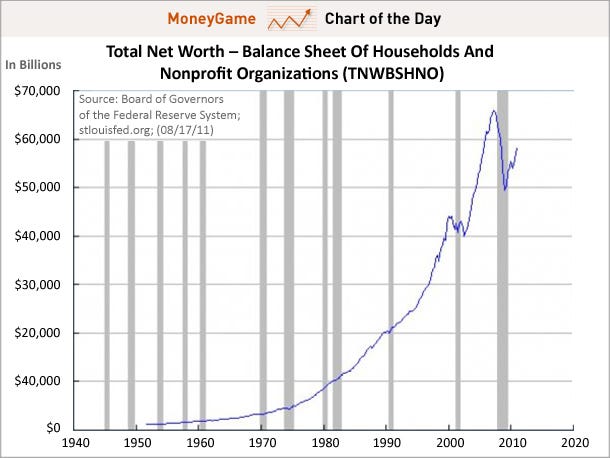
There are no clear number for unfunded liabilities, as the total debt varies between 60 Trillions and 115 Trillions. But consider this: The total net worth of households and non-profit organizations in the US amount to less than 60 Trillions as of today (See Business Insider Chart below).


Such a large amount of debt will never be repaid, and the US has few options:
  • Default on the debt directly. This is highly unlikely.
  • Massively cut expenditures (e.g. military) and decrease benefits (social security, unemployment benefits) and possibly increase taxes at the same time. This is not very likely and its implementation may not be successful. This would actually be supportive for the US dollar, but painful for the economy in the short term (1 to 2 years).
  • Print more money (e.g. Quantitative easing) in order to pay for debt. This is called monetization of debt. This is the easy way out and the most likely. However, this creates inflation and will lead to a decline in the value of the USD dollar overtime and may even lead to a full blown currency crisis leading to hyperinflation.