Showing posts with label dollar. Show all posts

Tuesday, July 31, 2012

Axel Merk: Gold at ECB: Accident or Strategy?

Axel Merk discusses the relatively constant Gold to Asset ratio at the ECB (15%) in his latest Merk Insight letter and tries to analyze if this is done on purpose.

Here's the full letter:

When the euro was launched, the European Central Bank (ECB) held approximately 15% of its assets in gold. That ratio has remained reasonably stable, giving rise to a variety of chatter, including suggestions that it may displace the U.S. dollar. We pursue the question on whether the ECB’s gold holdings are an accident or strategy.

Let’s look at the numbers. Below is a chart depicting the percentage of gold relative to the ECB’s total assets. As one can see, the percentage has remained reasonably stable despite a significant growth in total assets.
ECB Gold Holdings and Gold Price
Total assets of a central bank may be considered a proxy for the amount of money that has been “printed”; it’s a crude measure as it does not reflect physical money printed; nor does it reflect money in circulation; neither does it reflect sterilization activities that also show a rise in assets. Still, a central bank balance sheet is often referred to as the printing press as money is literally created out of thin air (by the stroke of a keyboard) when assets are purchased. Federal Reserve (Fed) Chairman Bernanke has referred to this fiat money feature as the printing press. We like to think of it as super-money, as central bank purchases provide cash to the banking system, allowing them to lend a multiple of the money that has been “printed”. While banks have been reluctant to lend (the velocity of money has been low), the analogy we like to give is that if you give a baby a gun, just because no one gets hurt does not mean it is not dangerous. That said, let’s look at total assets at the ECB:
ECB Gold Holdings As % Of Total Assets
The interpretation shows that while money can be printed, wealth cannot be created out of thin air: as money is printed, gold has appreciated versus the euro. So while inflation has not shown up in indicators such as the Consumer Price Index, monetary easing is rightfully reflected in the price of gold.
Diving a little deeper to determine how much of this is strategy versus accident, let’s look at the gold holdings at the ECB once more:
ECB Gold Holdings: Value and Volume
The ECB marks its gold holdings to market, i.e. uses market prices for gold. The ECB was selling gold from the inception of the euro until the onset of the financial crisis; since then, the ECB’s gold holdings have remained stable. To understand the motivation, one needs to note that when one refers to ECB gold holdings, one is actually talking about Euro area gold holdings. While the ECB holds some gold, most gold is held by the respective central banks (this is not a discussion of where such gold is physically located):
Eurosystem Gold Holdings
Relevant is that each nation in the Eurozone pursues its own agenda with regard to its gold holdings. Germany has resisted political pressure within Germany to sell gold, as Bundesbank (Buba) profits would need to be transferred to the government; the hawkish Buba has indicated that it would be considered selling gold to help finance the government’s deficit. Italy, as one can see, has not sold any gold. Conversely, as a percentage of their holdings, the Netherlands had been rather eager to sell gold up until the financial crisis; Portugal, too, was an aggressive seller. As one can see, gold sales are not particularly related to the financial health of a Eurozone nation, but more to the cultural attitude in the respective nations towards gold.
Let’s cross the Atlantic to see whether the ECB’s gold strategy is undermining the U.S. dollar. The Fed’s gold stock is valued at $44.22 per fine troy ounce. For purposes of the chart below, we adjust the Fed’s gold holdings to market prices:
Fed Gold Holdings
Note that the chart above starts in 2006, so as to focus on the period of the financial crisis. The Fed has been more aggressive than the ECB in printing money. As such, the percentage of gold in relation to total holdings has declined at the Fed in a more pronounced fashion. There is clearly no perfect relationship between the size of the balance sheet and the price of gold, as other factors also influence the supply and demand of gold; however, increasing the supply of fiat money (dollar, euros) may decrease its value when measured in real assets, such as gold. We have in the past referred to the Fed as the champ in printing money (as measured by the percentage balance sheet growth since August 2008), although the Bank of England has, as of late, taken on that title. But we digress.
From what we see, central banks have been scared into holding gold since the onset of the financial crisis. Beyond that, we don’t see an active strategy at the ECB to keep its gold reserves at 15% of total assets. Instead, the ECB’s comparatively measured approach has simply lead to a reasonably stable percentage of gold reserves. Of course that was before ECB President Draghi said on July 26, 2012, that he shall do “whatever it takes to preserve the euro.” (an interpretation of that may be that more money printing is on the way). For now, the cultural differences in responding to the financial crisis (Europe: think austerity; US: think growth) suggest that the euro should outperform the U.S. dollar over the long term, assuming the not-so-negligible scenario of a more severe fallout from the Eurozone debt crisis won’t materialize.
It may help to keep in mind that historically inflation is the response to a deflationary shock. If market forces were left to themselves, we believe the credit bust of 2008 would have caused a major deflationary shock. It’s the reaction of policy makers that fight market forces that may lead to inflation. Bernanke as of late brushed off such pessimism. As the charts above show, however, gold has been a sensitive – and sensible I might add - indicator to the trigger-friendliness of our central bankers.

Tuesday, January 3, 2012

Peter Schiff: There is no safe haven in currencies!

Peter interview on CNBC Fast Money on 30th of December 2011. He explains the Euro short trade is crowded and Gold is still under-owned. 

Every central bank is printing and people are looking for currency alternatives such as Gold.

Jim Rogers: Buy the Euro and the Swiss Franc in 2012

Apparently, despite all the talks about a currency crisis in Europe, I'm not the only one to think the Euro may be a buy in 2012, as Jim Rogers was interviewed on CNBC on the 3rd of January 2012 saying he would consider investing in the European currency along with the Swiss Franc. The main reasons he wants to invest in the Euro are the large short position in the Euro and the fact that it is an election year in France, so they will probably do something (spend money or monetize the debt) to make the market feel better for a while. However, he believes this would be a terrible mistake and we'll have to pay the price in 2013-2014.
I'm also worried about the Japanese Yen, as in the last few month they had a trade deficit. If this persists, it would be negative for the Yen. I suppose Jim Rogers plans to convert some of his Japanese Yen holdings into Euro and CHF.

Friday, December 2, 2011

Peter Schiff: The Real Currency Crisis is Coming to the US

Interview with Peter Schiff on Fox Business News (1st of December 2011) where he explains the Eurozone has severe problems but it's nothing in comparison to the United States and that the real currency crisis is coming to the US to the dismay of Fox Business host.

Friday, September 9, 2011

David Morgan - The Currency Crisis Continues

David Morgan of http://www.silver-investor.com is interviewed by Stellaconcepts on the 8th of September 2011.

David Morgan explains the currency crisis continues (citing the Euro crisis) and that Gold is not in a bubble.

He also gives a possible target of 5000 USD for one ounce of Gold, but as he believes it's actually the fiat currencies that go down instead of Gold going up, he prefers to see the price of Gold in terms of ratio to the stock market or silver. He except the Gold to Silver ratio to return to its historical ratio of 16.

He is very bullish on Silver because of 3 reasons:
  1. There 66% less silver than during the 1980 bull market
  2. Back then, it was mainly a US market and now it's a global market
  3. Internet is there and allow people to quickly buy or sell
Finally, he gives his views on the Comex which he thinks will never (officially) default as there are mainly loopholes and he states that mainstream media is biased against Gold (the barbaric relic).


Tuesday, August 23, 2011

Axel Merk Remains Bullish on the Euro

Axel Merk, who manages Merk Hard Currency Funds (MERKX), is interviewed on the Daily Ticker (Yahoo Finance) by Aaron Task on the 23rd of August 2011.

Merk thinks the Euro will outperform the US Dollar because the ECB prints less money than the Federal Reserve and Europe has implemented austerity measures, which we have yet to see in the US.

He also believes that after a European fiscal framework is implemented, we should see Eurobonds. However, he warns that this is a long process and there is no silver bullet to solve the current European currency crisis.


Thursday, August 18, 2011

Why is the US dollar a doomed currency ?

First of all, the US dollar is a weak currency because of the USA current account deficit which stands at 561 billions dollars in 2010 according to Wikipedia List of countries by current account balance. The US is actually last in this ranking (191), with Spain being number 190 with a current account deficit of 6.740 billions.

A large current account deficit is the result of an imbalance between exports and imports.

Second, the USA also has massive debt obligations with current government debt of 14.6 Trillions (Source: Debt Clock) excluding unfunded liabilities. That debt represented 92.7% of GDP in 2010 according to the IMF, and is close to 100% now. Some historical studies (cf. "Growth in a Time of Debt", Reinhart and Rogoff)explain that when a country debt to GDP is over 90%, the likelihood of paying down the debt decreases significantly as it affects economic growth rates negatively.

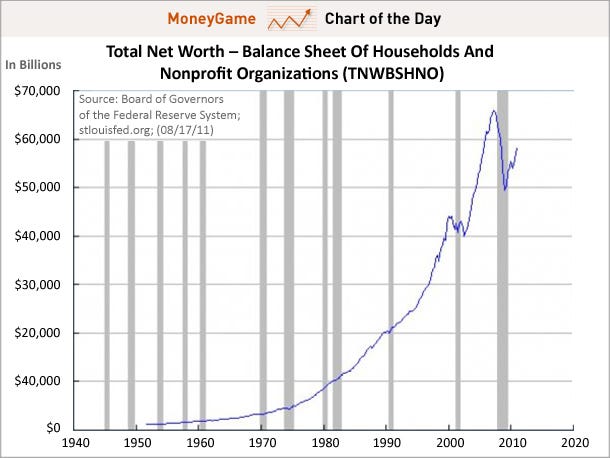
There are no clear number for unfunded liabilities, as the total debt varies between 60 Trillions and 115 Trillions. But consider this: The total net worth of households and non-profit organizations in the US amount to less than 60 Trillions as of today (See Business Insider Chart below).


Such a large amount of debt will never be repaid, and the US has few options:
  • Default on the debt directly. This is highly unlikely.
  • Massively cut expenditures (e.g. military) and decrease benefits (social security, unemployment benefits) and possibly increase taxes at the same time. This is not very likely and its implementation may not be successful. This would actually be supportive for the US dollar, but painful for the economy in the short term (1 to 2 years).
  • Print more money (e.g. Quantitative easing) in order to pay for debt. This is called monetization of debt. This is the easy way out and the most likely. However, this creates inflation and will lead to a decline in the value of the USD dollar overtime and may even lead to a full blown currency crisis leading to hyperinflation.
  • Monday, August 15, 2011

    Currency Crisis Definition

    A currency crisis - also called a balance-of-payments crisis - is a speculative attack in the foreign exchange market. It occurs when the value of a currency changes quickly, undermining its ability to serve as a medium of exchange or a store of value. Currency crises usually affect fixed exchange rate regimes, rather than floating regimes.

    A currency crisis is a type of financial crisis, and is often associated with a real economic crisis. Currency crises can be especially destructive to small open economies or bigger, but not sufficiently stable ones. Governments often take on the role of fending off such attacks by satisfying the excess demand for a given currency using the country's own currency reserves or its foreign reserves, historically usually in the United States dollar, Euro or Pound sterling.

    There are 3 generations of currency crisis models:

    • First generation models: Speculative attacks in the gold market (Fixed exchange rate with a commodity)
    • Second generation models: Doubts about whether the government is willing to maintain its exchange rate peg (Fixed exchange rate with another fiat currency)
    • Third generation models: Interactions between the problems in the banking and financial system and currency crises