He does not recommend buying real estate builder stocks however, as those have increased a lot recently and are likely to correct.
Showing posts with label usa. Show all posts
Showing posts with label usa. Show all posts
Tuesday, April 10, 2012
Marc Faber: Buy Real Estate To Protect Yourself Against Wealth Destruction
Marc Faber is interviewed on Yahoo Finance on the 9th of April 2012 where he explains that home prices in the south of the U.S., in Arizona, Georgia, Nevada and so fourth, are relatively inexpensive compared to other asset prices and recommend people to buy real estate to protect themselves - or as he puts it: "lose the least" - against massive wealth destruction when that happens. He further explains that he does not know when the collapse will happen, maybe when the Dow Jones is at 20,000, 100 millions or 100 billions depending on how much money Mr. Bernanke is ready to print.
He does not recommend buying real estate builder stocks however, as those have increased a lot recently and are likely to correct.
He does not recommend buying real estate builder stocks however, as those have increased a lot recently and are likely to correct.

Tuesday, January 17, 2012
US Debt Ceiling Breached Again
If the debt clock numbers are correct, the US debt now stands at 15.244 trillion dollars. Last summer, there was a long debate in the congress / senate to raise the debt ceiling to 15.194 trillion dollars (approved by the senate on the 8th September 2011). So now, early in 2012 (4 months later), it seems another debt ceiling debacle is in the making during a presidential year. That should be fun to watch.
Monday, December 26, 2011
Kyle Bass: Currency Crisis Coming in 3 to 5 Years
Kyle Bass 1 hour interview with AmeriCatalyst 2011 oin November 2011 on his view on the world today. That's very informative, even though it's rather depressing.
Interesting points including:
http://www.youtube.com/watch?v=5V3kpKzd-Yw
Interesting points including:
- Greece is bankrupt, a full mark down is required
- Western Economies will fail: Europe first, then Japan, then the USA.
- Japan has serious debt problems, most people will lose a third of their savings.
- Investors still don't want to accept reality
- PE are low, because E is too high and it will come down.
- We either take pain now, or we take apocalyptic pain later.
- Central banks will probably just print money and destroy the currencies.
- The US (government) has the same people who brought up in this mess, to fix the mess. It makes the US a laughing stock.
http://www.youtube.com/watch?v=5V3kpKzd-Yw
Friday, December 2, 2011
Peter Schiff: The Real Currency Crisis is Coming to the US
Interview with Peter Schiff on Fox Business News (1st of December 2011) where he explains the Eurozone has severe problems but it's nothing in comparison to the United States and that the real currency crisis is coming to the US to the dismay of Fox Business host.
Wednesday, November 2, 2011
The US Dollar, Gold and Politics
In his latest "Gold report", Peter Schiff talks about the politics of Gold investments where he analyses the price of Gold and the US dollar based on which US presidential candidate is elected President in 2012. Each candidate has different views on monetary policies and debt reductions. Here are the results:
To conclude, if Ron Paul is not elected president of the US, you can rest assured that your Gold investments will most probably do well for years to come.
- Herman Cain: Bullish for Gold, Bearish for the dollar
- Mitt Romney: Very Bullish for Gold, very bearish for the dollar
- Ron Paul: Bullish for Gold, Bullish for the dollar
- Rick Perry: Bullish for Gold, Bearish for the dollar
- Newt Gingrich: Bullish for Gold, Very bearish for the dollar
- Obama: The Gold Rush is On !
To conclude, if Ron Paul is not elected president of the US, you can rest assured that your Gold investments will most probably do well for years to come.
Wednesday, October 19, 2011
U.S. Dollar and Euro - Review and Outlook
Axel Merk & Kieran Osborne, CFA, Merk Funds have just published their outlook for the US dollar, the Euro, the Chinese RMB and several other currencies.
They have a bearish view on the US dollar:
The full outlook is available at http://www.merkfunds.com/merk-perspective/insights/2011-10-19.html
They have a bearish view on the US dollar:
Policy makers in Washington didn’t help appease market concerns: leaving the decision to raise the Government’s debt ceiling to the last minute only exacerbated market fears of a U.S. default and further degraded investor’s view of policy makers; ...Standard & Poors subsequently downgraded the credit rating of the U.S. government, citing the inability of the political leadership to come together and agree on a plan to sustainably rein in the deficit over the long term as a key reason for downgrade. We consider these developments have further eroded the safe haven and reserve currency status the U.S. dollar has held for so long, and continue to view the outlook for the U.S. dollar negatively over the medium to long term.even if in the short term there are risk, they are bullish on the Euro in the medium to long term:
...
minutes from the FOMC meeting show there was support for further expansionary monetary policy, or quantitative easing, which would constitute “QE3”. It is our assessment that the likelihood of the Fed instigating QE3 has risen significantly, in part due to the weakening economic outlook, but also because of the composition of voting members next year. All three dissenting voices will be replaced in 2012 and the average monetary policy stance of voting members will become much more dovish (only one voting member is considered a hawk – Jeffrey Lacker, the Richmond President)1. With inflation expectations declining, we consider Fed Chairman Bernanke may again present the need for further easing, arguing deflationary risks have become elevated, or at the very least, that further easing will not generate significant inflationary pressures. We believe the impending FOMC composition may consider this argument compelling, and is likely to err on the side of overstimulation. All of which leads us to believe that the outlook for the U.S. dollar remains to the downside.
Europe certainly has problems, but in an odd way, it is the inflexibility of its political make-up that may lead to a stronger euro over the foreseeable future. ...Finally, they mention they still have a positive view of the Chinese Yuan:
Many individual countries find themselves with very weak political leadership, but interestingly, have instigated, in many cases, very strict austerity measures with opposition support. The issues facing the Eurozone are significant, and there is no simple, easy solution; it’s likely to be a drawn out process rectifying years of malinvestment brought about by unconscionably low funding rates for periphery nations (Greece could borrow at rates similar to Germany for years leading up to the crisis). In turn, economic growth may be restrained over the foreseeable future. Note, however, that economic growth is not necessarily a precondition for a strong currency; it is not incompatible to have poor economic growth on the back of a strong currency – just look at Japan.
...
We believe two key reasons have contributed to Japanese yen strength – weak leadership and a current account surplus.
...
On the above two factors, the Eurozone is not so dissimilar to Japan: the Eurozone has a broadly balanced current account, fiscal union is disjointed at best, and many individual nations have very weak political leadership. Furthermore, the ECB has a sole mandate of price stability, and is reticent to provide any direct bailout funding or directed asset purchases to the financial industry, or specific sovereigns, for fear of overstepping its bounds (or being taken to court by the Germans).
...
As a result, we consider the euro can appreciate on the backdrop of weaker economic growth and continued divergence in monetary policies
We continue to see upside potential in the Chinese renminbi and believe policy makers will continue to be incentivized to allow the currency to appreciate to tackle domestic inflationary pressures.
The full outlook is available at http://www.merkfunds.com/merk-perspective/insights/2011-10-19.html
Saturday, October 15, 2011
The Death of the Euro
Here's an interesting debate about the Euro on CrossTak, RussiaToday on the 14th of October 2011.
How much liquidity is needed to save the Eurozone? Why go in more debt to overcome deadly indebtedness? And is Germany going to remain the prime sponsor of the euro experiment? Will we see the Eurozone change its boundaries? CrossTalking with Andrew Lilico (Clue: He's the man!), Jeff Madrick (Keynesian clown) and Jon Gaun (Eurosceptic) on October 14.
There is also an interesting part in the interview where they discuss whether TARP solved the US problem or not and Andrew Lilico compares the US debt situation with the one's of Italy.
Thursday, August 18, 2011
Why is the US dollar a doomed currency ?
First of all, the US dollar is a weak currency because of the USA current account deficit which stands at 561 billions dollars in 2010 according to Wikipedia List of countries by current account balance. The US is actually last in this ranking (191), with Spain being number 190 with a current account deficit of 6.740 billions.
A large current account deficit is the result of an imbalance between exports and imports.
Second, the USA also has massive debt obligations with current government debt of 14.6 Trillions (Source: Debt Clock) excluding unfunded liabilities. That debt represented 92.7% of GDP in 2010 according to the IMF, and is close to 100% now. Some historical studies (cf. "Growth in a Time of Debt", Reinhart and Rogoff)explain that when a country debt to GDP is over 90%, the likelihood of paying down the debt decreases significantly as it affects economic growth rates negatively.
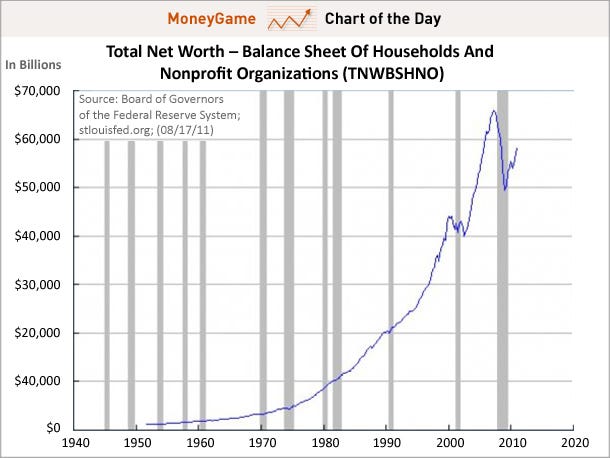
There are no clear number for unfunded liabilities, as the total debt varies between 60 Trillions and 115 Trillions. But consider this: The total net worth of households and non-profit organizations in the US amount to less than 60 Trillions as of today (See Business Insider Chart below).
Such a large amount of debt will never be repaid, and the US has few options:
Default on the debt directly. This is highly unlikely. Massively cut expenditures (e.g. military) and decrease benefits (social security, unemployment benefits) and possibly increase taxes at the same time. This is not very likely and its implementation may not be successful. This would actually be supportive for the US dollar, but painful for the economy in the short term (1 to 2 years).
Print more money (e.g. Quantitative easing) in order to pay for debt. This is called monetization of debt. This is the easy way out and the most likely. However, this creates inflation and will lead to a decline in the value of the USD dollar overtime and may even lead to a full blown currency crisis leading to hyperinflation.
A large current account deficit is the result of an imbalance between exports and imports.
Second, the USA also has massive debt obligations with current government debt of 14.6 Trillions (Source: Debt Clock) excluding unfunded liabilities. That debt represented 92.7% of GDP in 2010 according to the IMF, and is close to 100% now. Some historical studies (cf. "Growth in a Time of Debt", Reinhart and Rogoff)explain that when a country debt to GDP is over 90%, the likelihood of paying down the debt decreases significantly as it affects economic growth rates negatively.
There are no clear number for unfunded liabilities, as the total debt varies between 60 Trillions and 115 Trillions. But consider this: The total net worth of households and non-profit organizations in the US amount to less than 60 Trillions as of today (See Business Insider Chart below).
Such a large amount of debt will never be repaid, and the US has few options:
Subscribe to:
Posts (Atom)